Open-source app · Curriculum · Guides · Evidence
Healthy Future
Free tools for running a maternal and child health home-visiting program: CareLoom, an open-source app that community health workers use to schedule visits and deliver a stage-based curriculum, and the Healthy Future curriculum itself.
The app: CareLoom
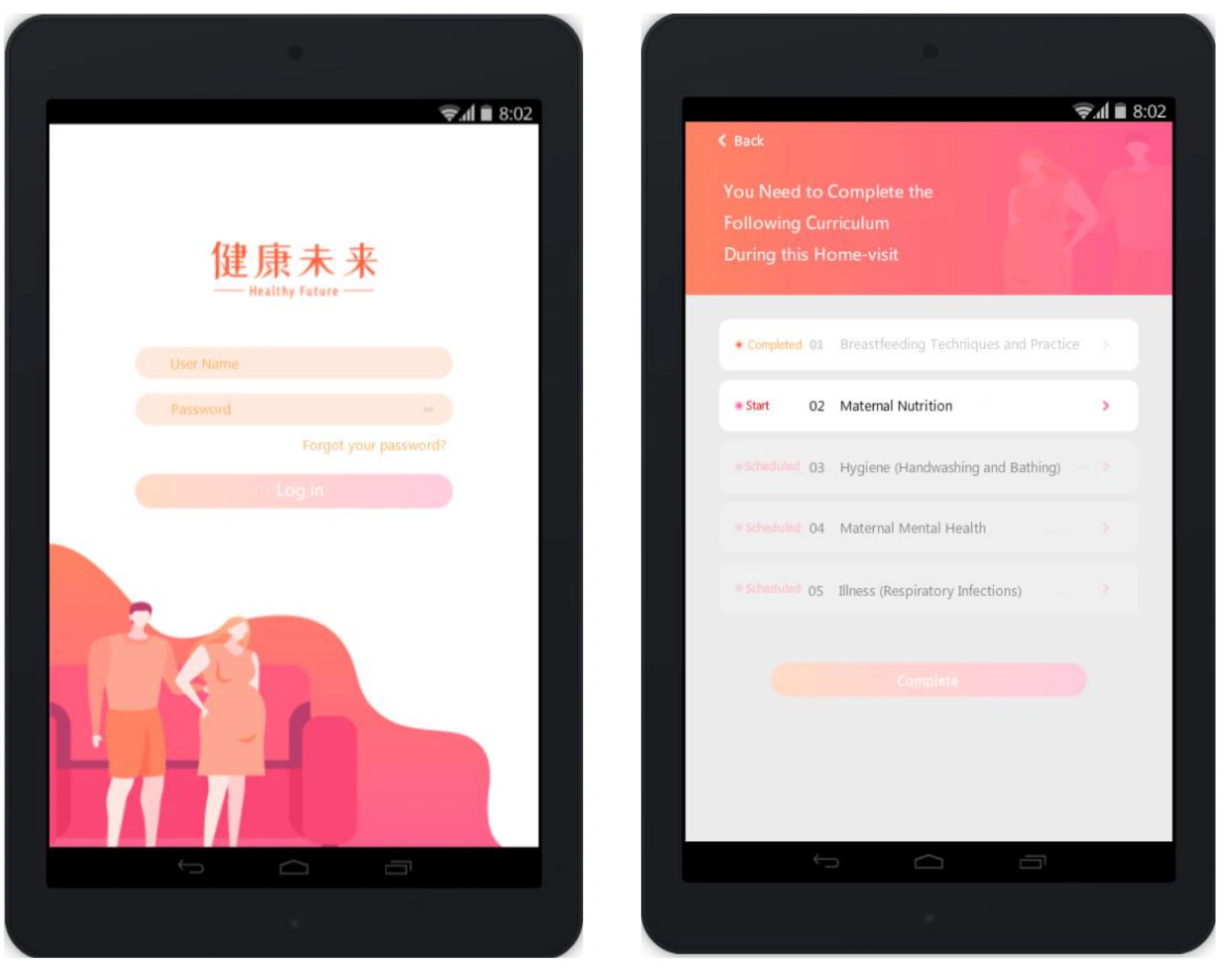
CareLoom (formerly VisitLink) is the open-source platform behind the Healthy Future app, released under the Apache License 2.0. It assigns content to each home visit based on pregnancy stage or the baby’s age, schedules visits, and gives supervisors data to monitor visit timeliness and quality.
Admin dashboard
Web interface where program managers design curricula, manage CHWs, and monitor visits.
Mobile app
Android app (Expo/React Native) that CHWs use to run home visits with structured curricula. Works offline.
API service
Spring Boot backend for data, authentication, and curriculum management. English and Chinese supported.
AI-enhanced content recommendations, French language support, and iOS are on the repository’s planned v2 roadmap. They are not available yet.
The curriculum
The Healthy Future curriculum is the script community health workers use on home visits: 26 sessions covering pregnancy and infancy, from 4 months of pregnancy to 18 months after birth.
Sessions cover maternal nutrition, breastfeeding, transition to solid foods, hygiene and illness prevention, caregiver mental health, and uptake of government health services. Each session ends with a knowledge and attitude check, and special modules cover formula feeding. [curriculum]
Healthy Future Program © 2022 by Stanford University is licensed under Creative Commons Attribution-NonCommercial 4.0 International (CC BY-NC 4.0).
User guide and setup help
The documentation lives in the CareLoom repository so it stays current with the code.
For program implementers
- Implementer guide (start here) — For program managers and NGO staff. No coding experience required.
- First setup — Organization, admin and CHW accounts, uploading curriculum content.
- Curriculum management — Stages, modules, components, and visit scheduling.
- Managing CHWs — Adding community health workers and supervisors.
- Monitoring visits — Visit completion, reports, and data export.
- Security — Changing default passwords, HTTPS, backups, access control.
- Localization — Language support (English and Chinese today).
For developers
The evidence
Healthy Future was evaluated in a three-arm cluster-randomized controlled trial in 119 rural townships in four nationally designated poverty counties of Nanchong Prefecture, Sichuan Province, China. The trial enrolled 1,308 pregnant women and caregivers of infants under 6 months, with baseline in mid-2021 and endline in mid-2022.
-
Published article
Balakrishnan S, Chen Y, Darmstadt GL, Sylvia S, Garn JV, Friedman SA, Weber AM. Uncovering hidden patterns: use of infant feeding profiles in the first 6 months postpartum to inform the effectiveness of breastfeeding promotion programs. Frontiers in Public Health. 2026;14.
doi:10.3389/fpubh.2026.1754431 -
Preprint (not yet peer reviewed)
Chen Y, Wu Y, Weber AM, Medina A, Guo Y, Balakrishnan S, Zhang H, Rozelle S, Zhou H, Darmstadt GL, Sylvia S. Effect of a digitally-enabled, stage-based intervention on maternal and child health: a community-based, cluster-randomized controlled trial from rural China. medRxiv. 2026.
doi:10.64898/2026.03.27.26349570 -
Study protocol
Chen Y, Wu Y, Dill S-E, Guo Y, Westgard CM, Medina A, Weber AM, Darmstadt GL, Zhou H, Rozelle S, Sylvia S. Effect of the mHealth-supported Healthy Future programme delivered by community health workers on maternal and child health in rural China: study protocol for a cluster randomised controlled trial. BMJ Open. 2023.
doi:10.1136/bmjopen-2022-065403 -
Trial registration
A healthy future for young children in rural China: evaluating a community health worker program to improve maternal, newborn and child health. ISRCTN16800789. 2021.
doi:10.1186/ISRCTN16800789
Background
Healthy Future was developed by a multidisciplinary team from Chinese and US academic institutions, in conjunction with China’s Ministry of Health, to improve child health and maternal well-being in rural China. [protocol] More on the program is on the Stanford REAP website (see Healthy Future Project).
Healthy Future 2.0 studies how AI-informed recommendations and family preferences can help prioritize home-visit content. It is in development. Project page →
Funders
- Healthy Future evaluation: supported by unrestricted gifts from the Enlight Foundation and private donors [protocol], with contributions from the Yeh Family Foundation and the Enlight Foundation [Frontiers 2026].
- Healthy Future 2.0: Cyrus Tang Foundation (Stanford prime award, UNC subaward).
Partner Institutions



Other materials
- Stanford Rural Education Action Program (REAP)
- Stanford REAP: Early Childhood Development and the Healthy Future Project
- Talk: “AI-Enhanced Curriculum Delivery for Community Health Workers: Evidence and Design from the Healthy Future Platform” (Stanford REAP Conference, Leuven, March 2026)
- Healthy Future 2.0 project page
- DHEPLab tools and platforms
Healthy Future is a collaborative project of Stanford University, the West China School of Public Health at Sichuan University, the University of Nevada, Reno, and the University of North Carolina at Chapel Hill.
Collaborators
Stanford University: Yunwei Chen, Gary L. Darmstadt, Sarah-Eve Dill, Yian Guo, Alexis Medina, Scott Rozelle, Hanwen Zhang
West China School of Public Health, Sichuan University: Yuju Wu, Huan Zhou
School of Public Health, University of Nevada, Reno: Siva Balakrishnan, Sarah A. Friedman, Joshua V. Garn, Ann M. Weber
Gillings School of Global Public Health, University of North Carolina at Chapel Hill: Sean Sylvia, Christopher M. Westgard
Listed from the author lists of the Healthy Future protocol and published studies.